
When OpenAI posted a job for an Employer Brand Manager, I found myself staring at the listing for longer than I expected.
Not because I was interested in the role.
Because I was interested in what it implied.
If there is one company that shouldn't need employer branding, surely it's OpenAI.
It's one of the most recognizable employers in the world. Millions of people use its products every week. Every major product launch becomes international news. People actively hope recruiters from OpenAI reach out to them. It has extraordinary awareness, enormous credibility, and no shortage of applicants.
If employer branding were simply about getting your name out there, OpenAI solved that problem years ago.
And yet they're hiring.
That should make every talent leader stop and ask a different question. If the company with arguably the strongest employer pull in the world believes it needs someone dedicated to employer branding, what exactly does that person do?
Because whatever the answer is, it clearly isn't "posting on LinkedIn a little more."
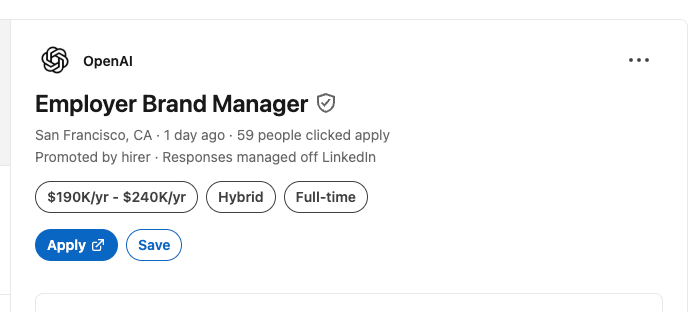
We've misunderstood the job
For years, employer branding has been sold as an awareness problem.
Build the brand.
Increase reach.
Become an employer of choice.
Generate more applicants.
Those aren't bad outcomes, particularly for companies that struggle to attract attention. But they're increasingly the wrong definition of the work. Awareness gets you into the conversation. It doesn't help someone decide.
OpenAI doesn't need another million people to discover it exists. It doesn't need a bigger top of funnel. It certainly doesn't need more unqualified applicants clicking Apply because they recognize the logo.
If anything, I'd guess the opposite is true. The challenge isn't generating demand. It's helping the right people understand why this role, this team, and this moment at OpenAI is more compelling than every other opportunity available to them.
That's a completely different job.
Every company competes at the moment of choice
One of the biggest mistakes we make in talent acquisition is assuming companies compete for attention.
Most don't.
They compete at the moment of decision.
The software engineer deciding between OpenAI, Anthropic, Google DeepMind, and Meta isn't wondering which companies exist. The civil engineer comparing Freese and Nichols with Halff and Kimley-Horn already knows all three. The electrician choosing between Clark Construction and Rosendin doesn't need another recruiting ad to become aware of either company.
They're trying to answer a much harder question: Which one gives me the future I actually want?
That's the moment employer branding exists for.
Not the first impression. The final decision.
This is exactly why so many career sites fail
Over the past year I've read hundreds of Fortune 500 career sites. Individually, many of them are well written. Collectively, they're almost impossible to tell apart.
Everyone promises growth. Everyone talks about purpose. Everyone celebrates collaboration, innovation, and making an impact. They're all true. They're also all expected.
The irony is that the companies themselves are often genuinely different. Different business models. Different leadership styles. Different opportunities. Different cultures. Different career trajectories.
Candidates never get to see most of that because it gets translated into language that could belong to almost anyone.
That's where employer branding earns its keep. Not by inventing a clever tagline, but by making the company's actual differences visible enough that a candidate can make an informed choice.
AI only raises the stakes
This matters even more now because AI is rapidly flattening communication.
Job descriptions are getting better.
Recruiter outreach is getting better.
Career site copy is getting better.
That's wonderful, until you remember that everyone has access to the same tools. If everyone can create competent content, competence stops being a competitive advantage.
What becomes valuable isn't better writing. It's clearer thinking.
The companies that win won't be the ones publishing the most content. They'll be the ones that have done the hard strategic work of understanding exactly why someone should choose them instead of another equally attractive option. AI can express that idea beautifully, but it can't invent it.
OpenAI is telling us something
I obviously don't know why OpenAI created this role.
Maybe it's hiring at unprecedented scale. Maybe it wants to improve candidate experience. Maybe it wants to articulate its mission more clearly. There are dozens of perfectly reasonable explanations.
But I don't think the specific reason matters.
What matters is that one of the most sought-after employers on earth looked at its hiring challenges and concluded that employer branding deserved investment.
That's remarkable.
Most companies are nowhere near as well known. They have fewer resources, less awareness, weaker reputations, and far more competition for talent. Yet many still think employer branding is something to worry about later, once they're bigger, or once recruiting gets harder.
OpenAI has already achieved what most companies think employer branding is supposed to accomplish, and it still believes the discipline matters.
Perhaps that's because employer branding was never about becoming famous.
Perhaps it was always about becoming easier to choose.
And if the most desirable employer in the world still thinks that work is worth doing, it's worth asking why everyone else believes they can afford to skip it.
I actually think the title contains the seed of a broader series you've been circling for months:
If OpenAI needs employer branding, why doesn't every company?