.png)

Five stages between "we need people" and "the right people choose us." Most companies skip the first three and wonder why the last two keep failing.
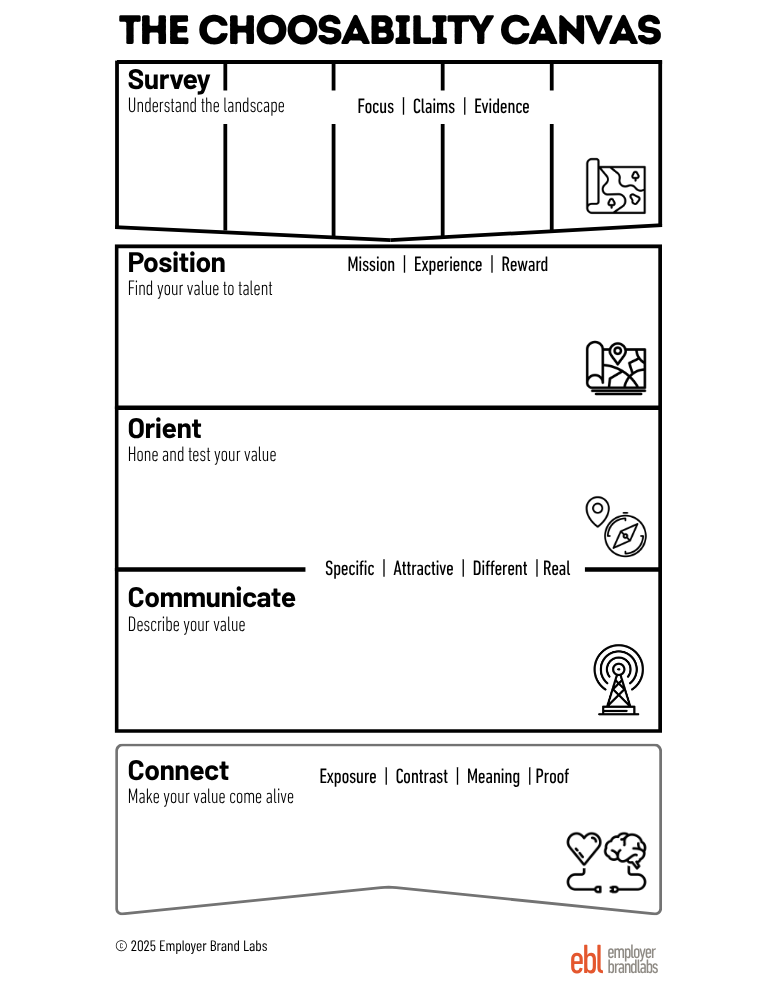
The Choosability Canvas is the operating map for making a company easier for the right people to choose. It has five stages, in order: Survey the market you are actually competing in, Position against what everyone else is saying, Orient the organization around what you can prove, Communicate the value where candidates make decisions, and Connect the message to every hiring conversation. Each stage produces something the next one needs. Skipping ahead does not save time; it just moves the failure downstream, where it costs more.
The problem the Canvas solves
Ask most companies to show you their employer brand work and they will show you outputs from stage four: a career site, a campaign, some posts, a video. Ask what those outputs are built on and the room gets quiet, because the honest answer is instinct, precedent, and whatever the review committee would approve.
That is not a character flaw. It is what happens when a discipline gets defined by its most visible artifacts. Communication is the part of the work everyone can see, so it became the part everyone does, and the invisible stages that make communication worth doing got skipped. The Canvas exists to put the stages back in order.
The five stages
1. Survey: know the shelf you are sitting on.Candidates see the market the way a shopper sees a shelf: your role next to every alternative, all making similar claims. Most companies have never looked at their own shelf. Survey means reading the job posts you compete against, clustering the claims until you can see the category wallpaper, knowing what your rivals promise but cannot prove, and understanding what your target audience actually weighs when they compare. It produces the one document most employer brand work is missing: an honest picture of what you are up against. Without it, every downstream decision is a guess with good formatting.
2. Position: decide what you can win.Positioning is choosing the ground where you are genuinely strongest and the audience for whom that ground matters. It is a decision, which means it excludes things, which is why committees resist it. The raw material is your differentiated value: what is true here that is not true across the street, tested claim by claim against [SADR]. The output is a short set of claims that are specific, attractive to the people you actually need, different from the shelf, and provable. Not pillars. Claims. Pillars describe you to yourself; claims give a candidate something to evaluate.
3. Orient: get the organization holding the same story.The stage everyone skips, and the reason brand launches evaporate. If the recruiters, the hiring managers, and the interview panel each carry a different version of the story, the candidate experiences the average, and the average of five stories is mush. Orient means the intake meetings run on the positioning, the hiring managers can say the claims out loud with proof attached, and the interview process demonstrates what the message promises. It produces the least glamorous and most valuable asset in the system: consistency. A modest story told identically by everyone beats a brilliant story told only by the careers page.
4. Communicate: put the value where decisions happen.Now, and only now, the visible work: job posts, outreach, career site, campaigns, content. The difference is that each artifact is now an application of the positioning rather than an act of improvisation. And "where decisions happen" has expanded: candidates increasingly meet you through AI tools that read, summarize, and compare your public materials, which means communication now includes being legible to machines. A claim that lives only in a brand book does not exist at this stage; publish the proof where humans and LLMs can both find it.
5. Connect: close the loop at every yes-or-no moment.The last stage is where choosability compounds or leaks. Every screen, interview, follow-up, and offer either reinforces the story or quietly refutes it. Connect means the offer conversation restates the full value instead of collapsing into a number, the rejection email leaves the brand intact, and what the market says back, the declines, the repeated questions, the stalls, flows into the next Survey. The Canvas is a loop, not a checklist. Companies that treat it as a loop get smarter every quarter. Companies that treat it as a project get a launch, a plateau, and a refresh quote three years later.
The diagnostic: find where your effort stops
The fastest use of the Canvas takes one minute. Ask where your company's employer brand effort actually begins, and where it stops.
Almost everyone starts at stage four. The tells are downstream and familiar: the campaign was polished and the response was generic (skipped Survey and Position, so the message joined the wallpaper). The launch went well and faded in a quarter (skipped Orient, so the organization never carried it). Candidates love the recruiter and go cold after interviews (Connect is refuting what Communicate promised). Salary is doing all the closing (Position never happened, so the number is the only legible value on the table).
Read your symptoms, find the earliest stage you skipped, and start there. Not because the framework says so, but because every stage you skip gets billed to the stages that follow, with interest.
Where to go deeper
The Canvas is developed in full in [Becoming Choosable]. The claim test that powers Position is [SADR]. The cost of running stages out of order shows up in the [Talent P&L], and the fastest way to see your stage-four output the way the market does is with a synthetic audience at [The Panel].
One page, five stages, one rule: earn the right to communicate before you spend money doing it.