
You have lost a candidate to a giant before, and you have told yourself the comforting story: there was nothing to be done. They had the logo. They had the comp band. They had the name your candidate's mother recognizes at Thanksgiving. When a company with $50 billion in revenue wants the same person you want, you lose. That is just physics.
I want to show you why that story is wrong, and I want to show you with receipts.
Over the past months I scraped the career sites of the Fortune 500. All of them. Companies representing roughly $20 trillion in revenue and 30 million employees, each with an employer brand budget that would fund your entire TA function for a decade. Then I analyzed what they actually say to candidates: who the message is about, what promise leads, what motivation it targets, what the pitch distills down to when you strip away the stock photography.
If these companies were as dominant in messaging as they are in market cap, the data would be depressing. It is the opposite of depressing. The scrape reveals the single largest strategic opening I have ever seen in recruiting, and it is sitting there, undefended, for any mid-market company willing to look at it.
What $20 trillion sounds like
Start with the finding that tells you everything about the rest: 79% of Fortune 500 career sites talk about themselves more than the candidate. On 389 of 491 sites, we-words (we, our, us) outnumber you-words (you, your). The median site says "we" nearly twice for every "you," a ratio of 1.82 to 1, and 41% of sites use we-language at least twice as often as you-language. On the one page whose entire job is persuading a candidate, four out of five of the biggest companies on earth made themselves the subject of the sentence.
It gets stranger. When I distilled each company's pitch down to its single strongest line, 26% of those pitches begin with "To..." As in "To make a meaningful difference in..." That is mission-statement syntax. A candidate asked "why should I work here?" and the company answered with the line it wrote for shareholders. A candidate question, answered with a shareholder answer.
And before you assume they simply ran out of room: the median career site runs 646 words. The mean is 817. This is not a brevity problem. These are companies using several hundred words to transmit almost no differentiating information.
So what are all those words doing? Here is the map. I tagged each company's site by the primary motivation its message targets, the core reason it gives a candidate to choose them. Thirteen distinct motivations showed up across the dataset: growth, purpose, belonging, security, autonomy, money, status, flexibility, achievement, and so on. A whole atlas of human reasons to take a job.
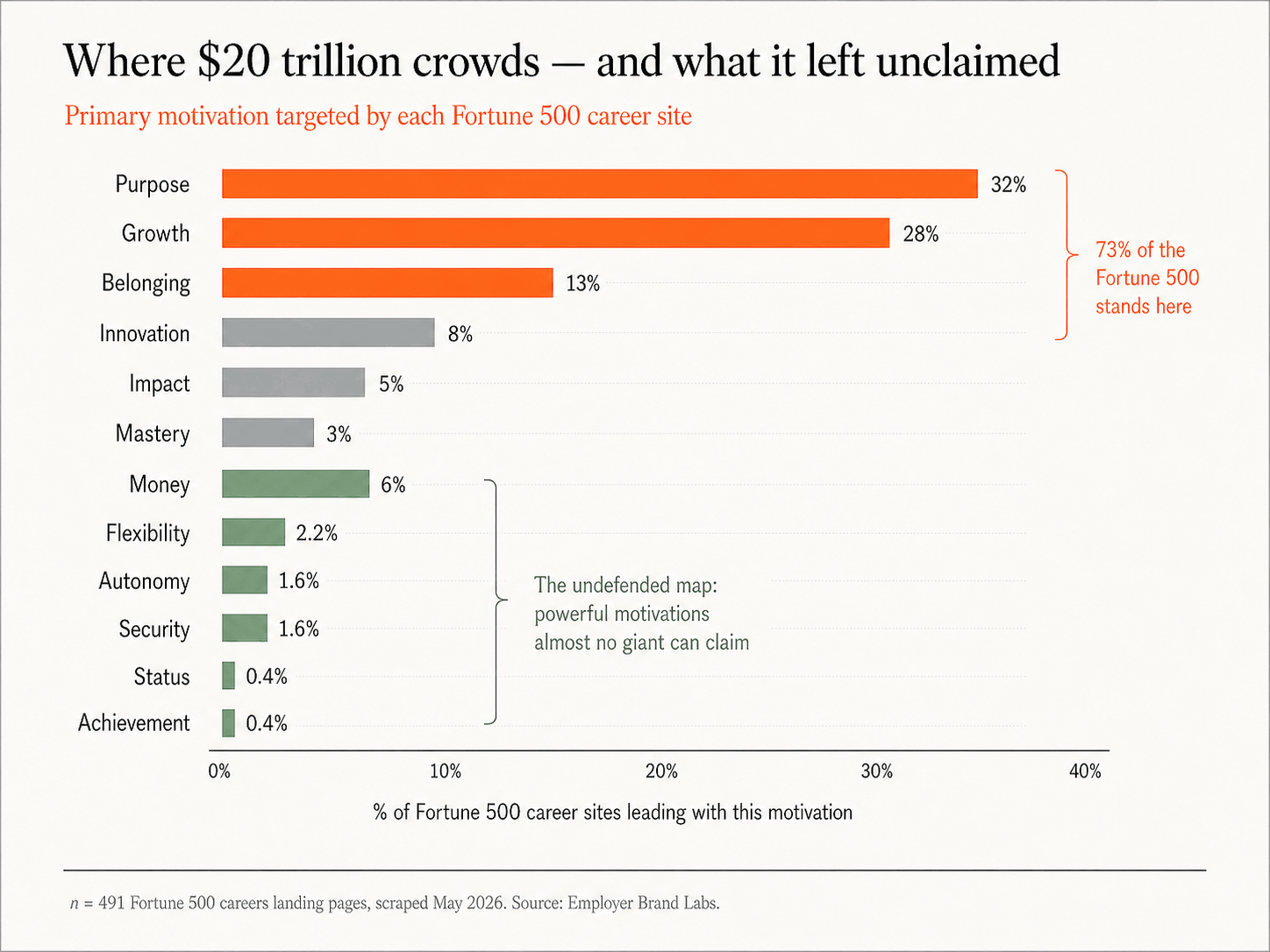
Here is how the Fortune 500 distributes itself across that atlas: Purpose leads on 31.5% of sites. Growth leads on another 28.6%. Two promises, 60.1% of the list. Add Belonging at 12.5% and three ideas cover 72.6% of the entire Fortune 500. Meanwhile the bottom seven motivations on the map, Flexibility, Security, Support, Autonomy, Integrity, Status, and Achievement, are claimed by 46 companies combined. Seven entire categories of human motivation, defended by fewer than one company in ten.
The individual sentences are just as crowded. "Innovation" appears on 42% of Fortune 500 career sites. "Our people" on 36%. "Purpose" on 35%. "Thrive" and "empower," two words no human being has ever said out loud in a bar, appear on a third of them each. The connective tissue is even more uniform: "join" shows up on 74% of sites, "culture" on 68%, "benefits" on 61%, "mission" on 34%. The median Fortune 500 career site uses three or more of the ten hallmark phrases I tracked. Nearly half use four or more. This is not messaging. This is a chorus.
And when you look at the distilled one-line pitches side by side, the sameness becomes almost comic. An oil refiner, an engine manufacturer, and an elevator company each reduce to the identical promise: "exceptional career growth opportunities." A trucking company and an insurance holding company both distill to "a clear path for career growth and advancement." A telecom giant and a global insurer both boil down to "meaningful career growth," word for word. Companies in completely different industries, doing completely different work, telling the same candidate the same thing in the same words.
Run the red pen test across the whole cohort, cross out each name and swap in a competitor's, and the overwhelming majority of these sites survive the swap without a scratch. Twenty trillion dollars of enterprise, speaking in one voice, and the voice says: meaningful growth opportunities at an innovative, purpose-driven, people-first company.
[Think you could tell them apart? I bet you can't! Take the quiz here.]
Why they cannot fix it
Here is the strategic insight, and it is the whole game: this sameness is not a mistake the Fortune 500 will correct. It is a structural property of being the Fortune 500.
Think about what a claim has to survive to reach a giant's careers page. Legal review across a dozen jurisdictions. Brand governance. HR sign-off. Comms sign-off. The implicit test at every gate is not "is this compelling?" It is "could this sentence embarrass us, exclude someone, or be untrue for any of our 300,000 employees?" A company that operates call centers, research labs, warehouses, and a trading floor cannot say anything specific about the work, because no specific statement is true everywhere. So the message gets abstracted upward until it is true for everyone, at which point it is information for no one. The committee is not failing. The committee is doing exactly what committees exist to do, and the output is the linguistic average of everything the company cannot risk saying.
The second conformity machine
The committee is only the first machine. Industry convention is the second, and it runs in exactly the place candidates do their comparison shopping.
Within industries, the clustering gets dramatically worse. 85% of pharmaceutical companies lead with Purpose. Across all 64 healthcare and pharma companies on the list, 73% lead with Purpose. Commercial banks: 55% lead with Growth. Utilities: 52% Purpose. Semiconductors: 43% Innovation.
Sit with what that means for the actual moment of choice. A nurse weighing three health systems, or an analyst weighing three banks, is not comparing three arguments. She is reading three versions of the same sentence and being asked to choose between them on vibes and comp. The sameness is worst precisely where candidates compare hardest, because every company benchmarked its message against the neighbors it most needs to beat, and the benchmark became the message.
You do not have that machinery. You do not have the twelve-jurisdiction legal review, and you are not chained to a sector script. That is not a gap in your maturity. That is your entire strategic advantage, and most mid-market companies spend it imitating the constraint they were lucky enough to be born without.
So here is how I would beat them. Not everywhere, because you do not need to win everywhere. You need to win the specific candidates you actually want, and for that fight, the giants have left most of the map undefended.
[Subscribe to get new content like this!]
The playbook
1. Claim an abandoned motivation. Go back to that motivation map. If 72.6% of the Fortune 500 is crowded onto purpose, growth, and belonging, look at what is sitting nearly empty. Security: 1.6% of companies lead with it, in an era of visible layoffs at the biggest names in tech. Autonomy: 1.6%, while every senior candidate on the market is quietly desperate to escape process bloat. Flexibility: 2.2%, and the whitespace shows up in the copy itself, where only 11% of sites even mention "remote" and 7% mention "hybrid." Money, stated plainly as the reason: 6.3%. Status and achievement, combined: five companies out of five hundred. These are not weak motivations. They are powerful motivations the giants cannot lead with, because a company with 300,000 employees cannot promise autonomy, and a company doing layoffs cannot promise security without a lawyer fainting. Pick the abandoned motivation that is genuinely true of you and make it your lead. You will be, almost literally, the only voice in that part of the market.
2. Say the number. Here is my favorite absolute in the entire dataset: zero of 491 Fortune 500 career sites use the phrase "pay range." Not one. Only 3% mention "salary" at all. "Compensation" appears on 17%, almost always in legal boilerplate about equal opportunity. Twenty trillion dollars of revenue, and not one careers page tells candidates what the jobs pay, because internal equity across half a million employees makes transparency radioactive. You can publish the range, the bonus math, and the honest sentence "here is how raises actually work here" this afternoon. For every candidate exhausted by the compensation guessing game, and that is all of them, plain money talk from a company they have never heard of beats vague prestige from one they have.
3. Write like one person, because you are allowed to. Nothing on a Fortune 500 careers page was written by a person; it was written by a process. Remember the 79%: even the pronouns got committee'd into we, our, us. So the cheapest possible differentiation is a human voice with a name attached, talking to a "you." A hiring manager writing "here is what I actually need, here is what is hard about this job, here is what happened to the last person in the role, email me directly" is unthinkable at a giant. It requires no budget at yours. In a market where every message sounds like it cleared a committee, sounding like a person is a costly signal precisely because the giants cannot afford the risk of it.
4. Weaponize specificity. Of the 490 distilled one-line pitches in the dataset, only 3% contain a single number. Not revenue, not team size, not a year, not a percentage. Four hundred and eighty-seven of the most measured, metric-obsessed companies on the planet, and their best pitch to candidates is number-free. The giants abstract because they must. You can name things: the customer whose business runs on your product, the revenue the codebase moves, the two people the new hire will learn from, the metric the role owns. One sentence of checkable fact outweighs a paragraph of "meaningful impact," because a third of the Fortune 500 is already saying "meaningful" and the word has been ground into static. Every specific claim you make lands in a candidate's feed surrounded by five hundred companies legally required to stay vague. The contrast does the marketing for you.
5. Carry your own proof. When a company cannot say anything specific about itself, it outsources the claim to a badge: 29% of Fortune 500 career sites mention an "award," 19% say "recognized," 8% cite Great Place to Work. Borrowed credibility is what is left when the committee has stripped out everything checkable. Which hands you the counter-move: proof you actually own. A named customer. A real employee's real outcome, with a name and a date. The retention number, the promotion rate, the actual Glassdoor sentence you are not afraid of. A certification logo says "an outside party was paid to agree we are fine." A checkable fact says "we are not afraid of you verifying this." Candidates can tell the difference, because the second one is rare.
6. Tell the ugly truth on purpose. No Fortune 500 careers page will ever say "the on-call rotation is rough two weeks a quarter" or "this job involves a lot of unglamorous data cleanup before the interesting work starts." Honesty about tradeoffs is the single claim their machinery most reliably strips out, which makes it the single claim that most reliably reads as credible coming from you. It repels the wrong candidates for free and makes every other sentence on your page more believable. You are not just being refreshing. You are making a claim your largest competitors are structurally forbidden to match.
7. Move at the speed of a decision, not a process. This one is not about words, but the scrape kept pointing at it: everything about giant-company hiring communicates process, and process communicates that the candidate is one of thousands. A same-day reply from a named human, an interview loop that fits in a week, a "here is exactly where you stand" note after every stage: these cost discipline, not dollars, and they land as the strongest possible proof of the autonomy and humanity your message claims. The giants cannot do this at scale. Scale is the thing you are competing against. Be fast where they are big.
None of these seven requires a budget line. All of them require the same underlying decision: to stop benchmarking the companies whose strategy depends on advantages you do not have, and start exploiting the weakness their advantages create.
I went looking for the escapees
One more finding, and I will be honest with you: it is not the finding I wanted.
Fifty-seven Fortune 500 companies, 12% of the list, use zero of the ten hallmark words. No "thrive." No "empower." No "our people." When that number came out of the analysis, I thought I had found the hopeful ending: proof that the committee can be survived, that somewhere inside the heaviest machinery on earth, someone fought a real sentence through to the page.
Then I read the 57, and the hopeful ending fell apart into something more interesting.
Most of them did not escape the chorus. They stopped singing entirely. These are companies who seem to bend over backwards to say as little as possible These pages avoid the hallmark vocabulary the way an empty room avoids clutter. No message, no promise, no argument. A search box with a logo on it. That is not differentiation. That is a vending machine.
A second group dodged my ten words and found other ones just like them. Valero avoids every hallmark phrase I tracked and still greets candidates with "Find Your Future. Be Exceptional." MassMutual clears the vocabulary screen with "Make an impact that matters." The chorus, it turns out, has more than ten words in it. Avoiding the specific clichés I measured is not the same as avoiding cliché.
What is left, after the vending machines and the synonym-swappers, is a residue of maybe eight companies with substantial copy that genuinely dodges the standard vocabulary, names like Target, Workday, HCA, Land O'Lakes, Oscar Health. Whether any of them is actually saying something distinct would take a human read to judge. Out of five hundred, the candidates for "genuinely different" fit on one hand, maybe two.
So here is the finding, corrected: at Fortune 500 scale, the alternative to the chorus is not distinctiveness. It is silence. When the machinery cannot produce the standard message, it does not produce a better one. It produces nothing. The giants' real menu has two items, conformity or abdication, and specificity is not on it.
Sit with what that does to the size of your opening. The motivation map showed seven categories of human motivation defended by fewer than one company in ten. This shows the deeper truth: the number of Fortune 500 companies making a specific, distinct, human argument to candidates rounds to zero. The territory is not lightly defended. It is empty.
The part worth saying to your executives
If you bring one idea from this into a leadership meeting, bring this one: the Fortune 500's employer messaging is not strong. It is heavy. Those are different things, and the difference is the opening.
Their brands are strong, their comp is strong, their gravity is real. But the message itself, the actual words doing the actual persuading at the moment a candidate decides whether to lean in, is the weakest part of their entire apparatus, because it is the part their scale actively degrades. I read five hundred of them. Four out of five talk about themselves instead of the candidate. A quarter answer "why work here?" with their mission statement. Not one will print what the job pays. The overwhelming majority could trade careers pages with a competitor and no one, including their own employees, would notice by the words alone.
You cannot outspend them. You do not have to. Sixty percent of the biggest companies on the planet are standing in the same corner of the map, saying the same two things in the same borrowed voice, and the rest of the territory, security, autonomy, honesty, money, specificity, speed, a human being with a name, is sitting there unclaimed.
They have every advantage except the one the decision actually turns on: the ability to say something true, specific, and theirs.
That one is still available. It goes to whoever says it first.
[Need to beat a "big company?" The Hiring Advantage Blueprint makes that possible.]
How I built this (and where it bends)
A claim about 500 companies deserves to show its work, so here is the method, including its limits.
The dataset. I started from the 2026 Fortune 500 list: 499 companies after delistings and mergers. For each, I located the primary careers landing page, the front door a candidate actually walks through, and captured its full rendered text using an automated scraping pipeline built with Firecrawl and Apify. The scrape ran in April 2026. I found working career site URLs for 496 companies and captured usable copy for 491; a handful of sites blocked scraping or returned only navigation. Motivation tagging produced usable classifications for 489.
What "the message" means here. I analyzed the careers landing page, not the full site. That is a deliberate choice, not a shortcut. The landing page is where a company puts its lead argument, the message it chose when it could choose anything. If the differentiation is not there, a candidate deciding in thirty seconds never finds it.
The analysis. Scraped pages were cleaned of navigation, image tags, and links, leaving the candidate-facing language. On that text I ran three layers of analysis. First, a phrase census: literal string matching for common employer brand vocabulary across all 491 sites. Literal matching undercounts, since it misses synonyms and rephrasings, so every sameness percentage in this piece is a floor, not a ceiling. Second, word-orientation counts, comparing company-referencing words (we, our, us) against candidate-referencing words (you, your) per site. Third, AI-assisted classification: each site's message was summarized into a perceived EVP, tagged against a thirteen-motivation taxonomy by primary motivation targeted, and distilled into the single strongest one-line reason to choose that company. I reviewed the classifications; the tagging involves judgment at the margins, but the headline concentrations are far too large to be artifacts of edge cases.
One tagging note: "Impact" (3.9%) shares language with "Purpose" in many one-liners. Merging them would push the purpose-family alone to 35.4% of the list. I kept them separate, which means every concentration figure above is the conservative version.
The limits. This is a snapshot in time of one page per company, in English, aimed at US candidates. Companies say more elsewhere: on job posts, on social, in interviews. But the landing page is the one message every company controls completely and every candidate sees first. That is the ground I measured, and on that ground, the findings are what they are.
The dataset behind this analysis is something I maintain and re-run. If you want to know how your own careers page reads against this field, that comparison takes about five minutes, and I am easy to find.