View
The New Dictionary of Hiring

Switching Burden

/SWICH-ING BUR-DUHN/
  NOUN

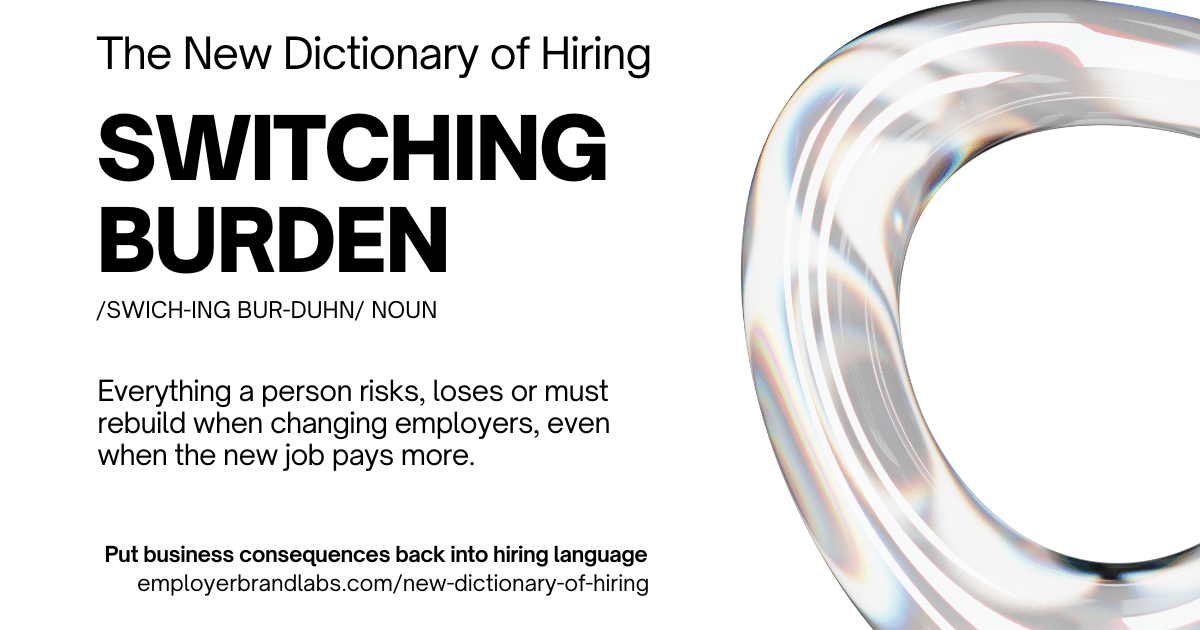
The Switching Burden is everything a person risks, loses or must rebuild when changing employers, even when the new job pays more.

MEANING

Relationships, reputation, influence, flexibility, knowledge, routines and certainty all have value. None appears on a payslip, but candidates know what they're worth.

‍

Recruiters naturally talk about what someone could gain. Someone who's doing well may be thinking just as hard about everything they could lose. Unless you understand that Switching Burden, a perfectly rational no can look like a baffling rejection of your “great opportunity.”

Defined by:
James Ellis,
Employer Brand Labs
Category:
Choice
The New Dictionary of Hiring card: Switching Burden, noun. Everything a person risks, loses or must rebuild when changing employers, even when the new job pays more. Abstract iridescent glass shape on a white background.

MAKE THE CHANGE

Instead of:
Evaluating an offer only by what the new company provides.
Ask:
What does this person have to give up in order to say yes to us?

EXAMPLE

A senior employee would gain money by leaving but lose influence, a trusted team and an arrangement that makes family life work. The salary comparison misses half the decision.

HOW TO USE IT

List what the people you need would risk or give up by moving. Address the important concerns through honest information, thoughtful offers and a realistic account of the new role.

SAY IT TO LEADERSHIP

We're asking people to give up more than a paycheck. Until we understand what they'd lose by joining us, we'll keep being surprised when a bigger offer isn't enough.

NOT TO BE CONFUSED WITH

Choice Friction: the Switching Burden is what the candidate gives up, and it exists before you do anything; Choice Friction is difficulty the employer adds.
More from
James Ellis
Subscribe
Weekly insights